.avif)


.avif)

.avif)







.avif)


The office your finance team signed off on last quarter is a health decision, whether or not anyone framed it that way at the time. So is the desk layout, the ventilation rate, the light your teams stare through for eight hours a day, and the small budget line that pays for cleaning the HVAC filters. Facilities decisions and benefits outcomes are the same conversation on a delay, and the delay is what makes them hard to see.
Start with one number. Thirty-three per cent of all orthopaedic telehealth consultations on Plum's platform correlate with poor posture and extended periods of sitting at work. That's from Plum's Employee Health Report 2025, and it lines up with what the international literature has been saying for years. A 2024 systematic review of work-related musculoskeletal disorders among computer users put annual WMSD prevalence at somewhere between 33.8% and 95.3% across the twenty-five studies it reviewed. The Plum report is direct about the implication for India: "quantitative evidence that sedentary lifestyle consequences manifest much earlier than previously recognised."
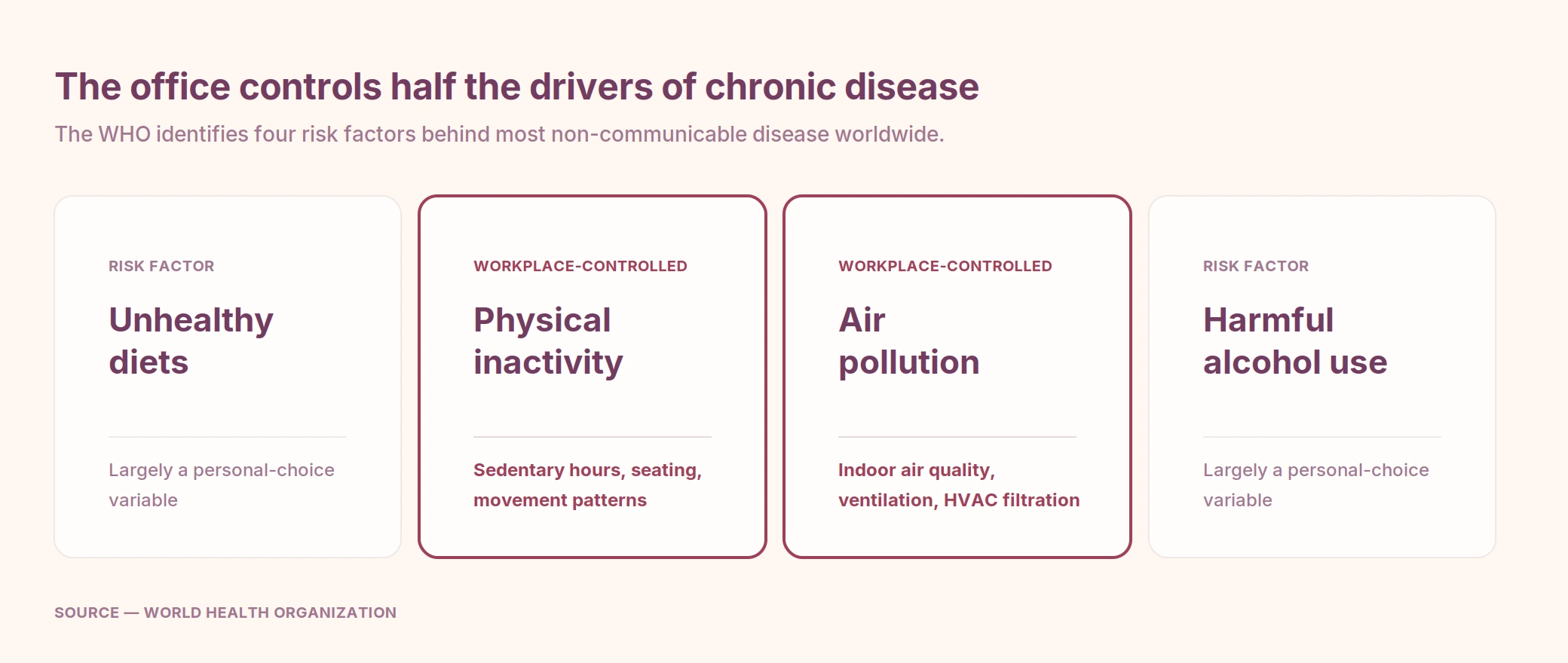
Musculoskeletal complaints are only the most visible symptom of a workplace that hasn't been designed with health in mind. The World Health Organization identifies four risk factors that account for most non-communicable disease worldwide: unhealthy diets, physical inactivity, air pollution, and the harmful use of alcohol. Two of the four, physical inactivity and air pollution, are things an office building materially controls. And there is now good evidence that indoor air quality doesn't only make employees sick over the long term. It affects how well they think today. A Harvard T.H. Chan School study across offices in six countries found that higher PM2.5 levels and lower ventilation rates were associated with slower response times and reduced accuracy on cognitive tests, at concentrations that are common in indoor environments.
The workplace is not decor. It is one of the largest health interventions your company makes, whether or not you think of it that way.
This is the structural problem. Seating, lighting, ventilation and desk layout are procurement decisions made by facilities or admin, budgeted as capex or opex, and defended on cost-and-aesthetics grounds. Health insurance and OPD wallets are procurement decisions made by HR, budgeted as benefits, and defended on retention grounds. Finance approves both, but nobody in the approval chain has an incentive to notice that the desk spec is correlated with the orthopaedic-claim ratio, or that the ventilation rate is correlated with productivity per employee.
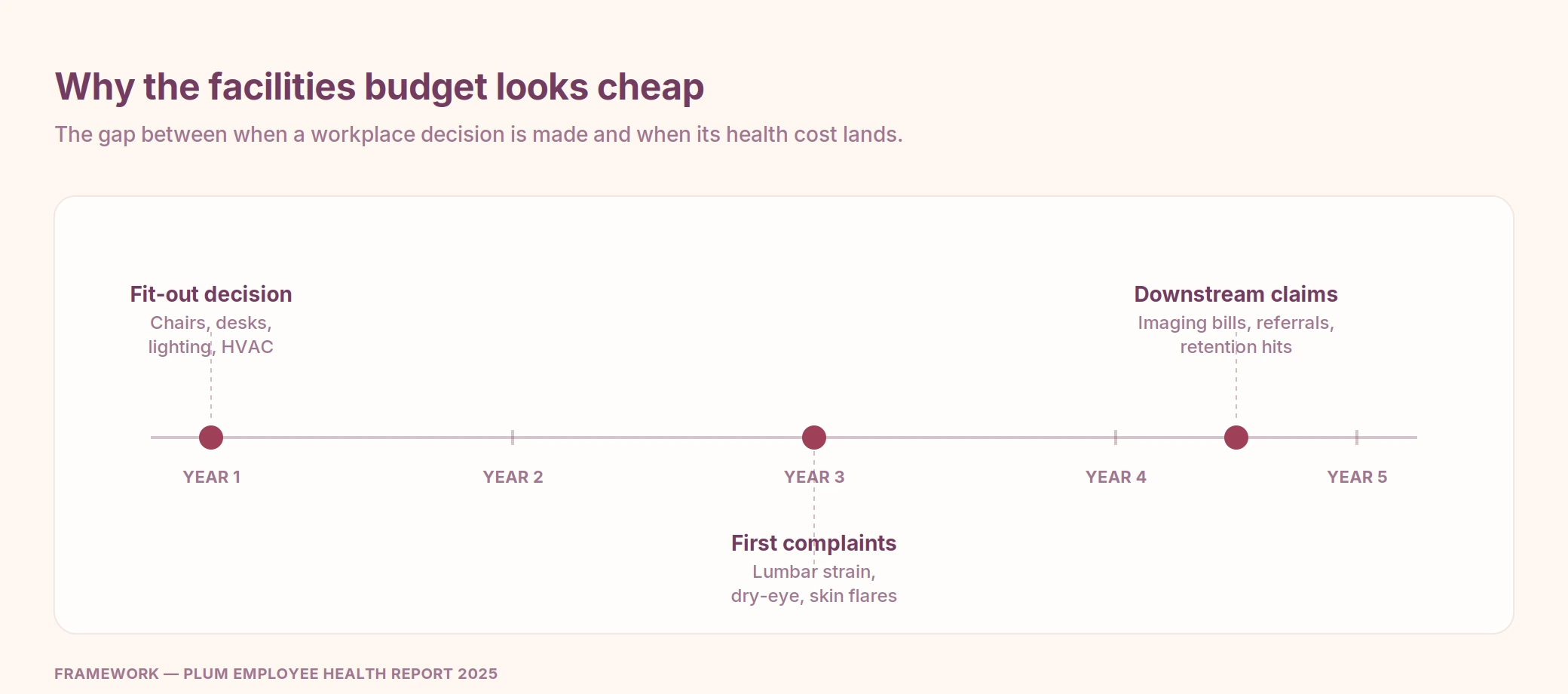
The lag is what makes it worse. A room full of budget-friendly desks and chairs a 28-year-old software developer spends her days at now produces a lumbar complaint by 33 and an imaging bill soon after. Poor lighting today shows up as chronic eye strain and skin flare-ups two or three years down the line. Under-ventilated meeting rooms cost cognitive throughput this quarter, but finance won't see it in a line item; they'll see it in retention numbers a year from now. By the time any of these claims land, the CFO who signed off on the fit-out has moved on, and everyone has quietly reduced their productivity by an amount nobody has bothered to measure.
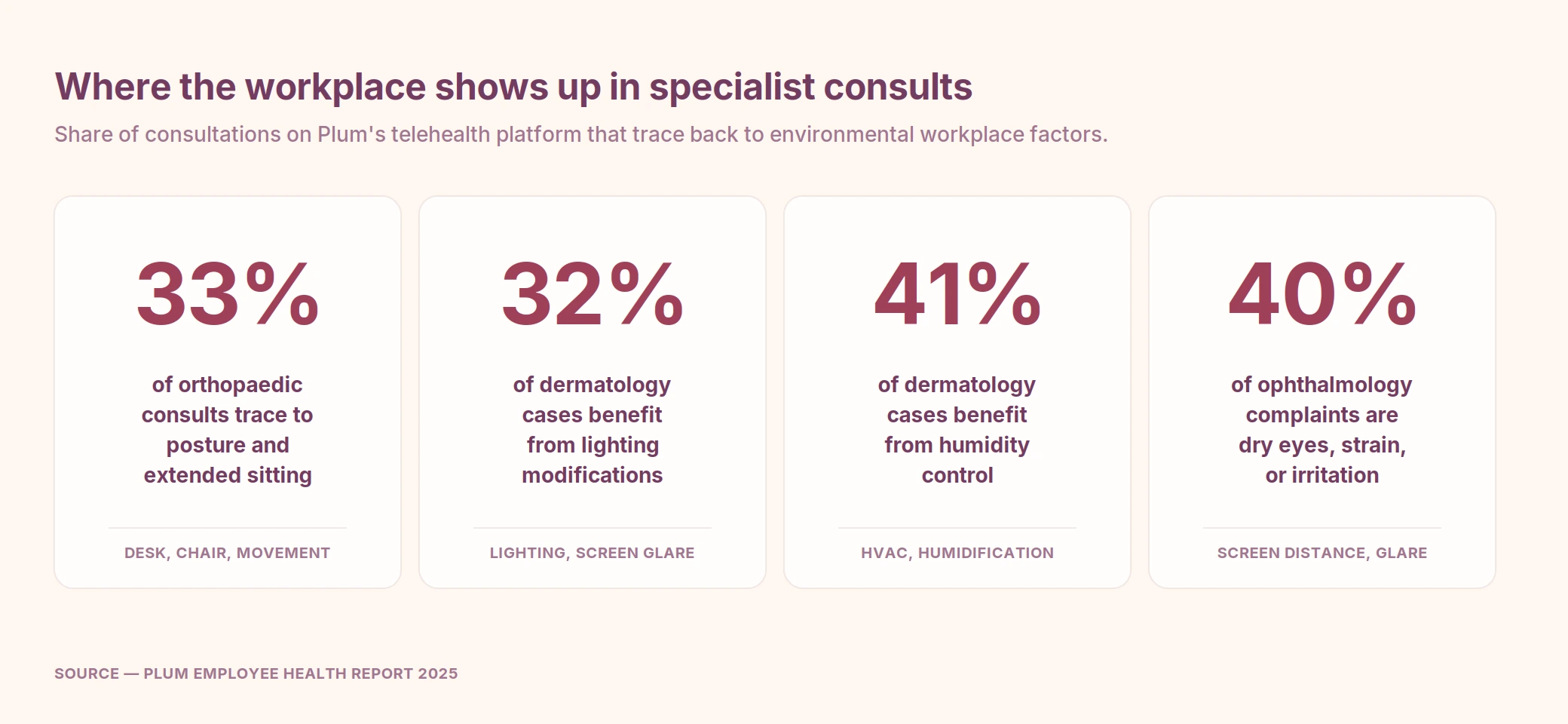
To see the same pattern outside orthopaedics, look at the dermatology and eye-strain data in the Plum report. Thirty-two per cent of dermatology cases the platform sees benefit from lighting modifications, and 41 per cent benefit from humidity control. Forty per cent of ophthalmology complaints on the platform are about dry eyes, strain, or irritation, which the report calls "a growing digital eye strain epidemic as device usage intensifies in the workplace." None of it gets fixed by insurance, and all of it traces back to a facilities decision made three to five years earlier.
The Plum report illustrates the point with the case of Divya, a 36-year-old team leader in a hybrid model, who sought help for persistent dark circles and dull skin that were making her self-conscious on video calls. The dermatologist attributed the flare-up to blue-light exposure and indoor air quality, worsened by erratic sleep. The prescription wasn't just skincare. It included a desktop humidifier, a blue-light protector, and workstation changes to reduce glare. Her skin cleared up, and so did her headaches. Skin, eyes, spine and mood all sit downstream of a small set of physical settings the company has direct control over.
Ergonomics, as the CDC defines it, is the fitting of work tasks and environments to the worker. Furniture is one node in that system, not the system itself.
The fix, on paper, is boring. Bring the benefits lead into the annual facilities budget conversation, and the facilities lead into the annual benefits review. Put a single slide in front of the CFO that shows both budgets on one page, with a line connecting environmental capex in year one to downstream claims and productivity loss in years three through five. The 33% orthopaedic figure is already available on any decent claims-analytics platform, and the environmental interventions have their own body of evidence, from the Harvard air-quality study to the growing systematic-review literature on workplace ergonomics.
Most Indian companies stop short of this integration because the incentives make it hard. Facilities budgets are small and easy to defend line by line, whereas benefits budgets are large and get scrutinised as a percentage of CTC. Expanding the facilities line to include health-linked capex complicates a conversation that used to be simple. On top of that, the ROI window is long enough that quarterly-focused leaders don't feel the effect. If you save ₹80 lakh on fit-out today, you get credit at this year's budget review. If that fit-out contributes ₹2 crore in incremental medical claims and lost cognitive throughput across the next four years, it will be someone else's problem.
The right response is not to add another approval layer to facilities decisions. It's to change what data the facilities decision is made against. A workplace audit that shows the CFO how much of last year's OPD spend correlated with environmental factors, from lighting to humidity to air quality to sedentary hours to screen strain, is a conversation-changer. Once that spend is quantified, the fit-out budget stops being a facilities line item and starts looking like the claims-prevention investment it always was.
The workplace became a health decision the moment your first employee walked into it. The question is only whether that decision gets made deliberately, with finance and benefits in the room, or by default, in a spreadsheet that lists desks and lighting well away from the medical bills they will one day generate.
Further reading
- Plum, Employee Health Report 2025 — the 33% posture-and-sitting figure, the WHO four-risk-factor framing, and the environmental-intervention benefit percentages for lighting (32%) and humidity (41%).
- Harvard T.H. Chan School of Public Health, Office air quality may affect employees' cognition, productivity — the six-country CogFX study linking PM2.5 and low ventilation rates to slower response times and lower accuracy on cognitive tests.
- Al Amin et al. (2024), A systematic review of work-related musculoskeletal disorders and risk factors among computer users — annual WMSD prevalence of 33.8% to 95.3% among computer workers.
- CDC/NIOSH, About Ergonomics and Work-Related Musculoskeletal Disorders — the "fit the job to the person" framing.