.avif)


.avif)

.avif)







.avif)


You won't find it on the calendar. Nobody in HR scheduled it. But the group that gathers by the back gate every couple of hours (a couple of engineers, someone from finance, one of the founders, occasionally the office manager) is having the closest thing your company still has to a genuinely cross-functional conversation. It's also, statistically, likely to include one in five of your total workforce.
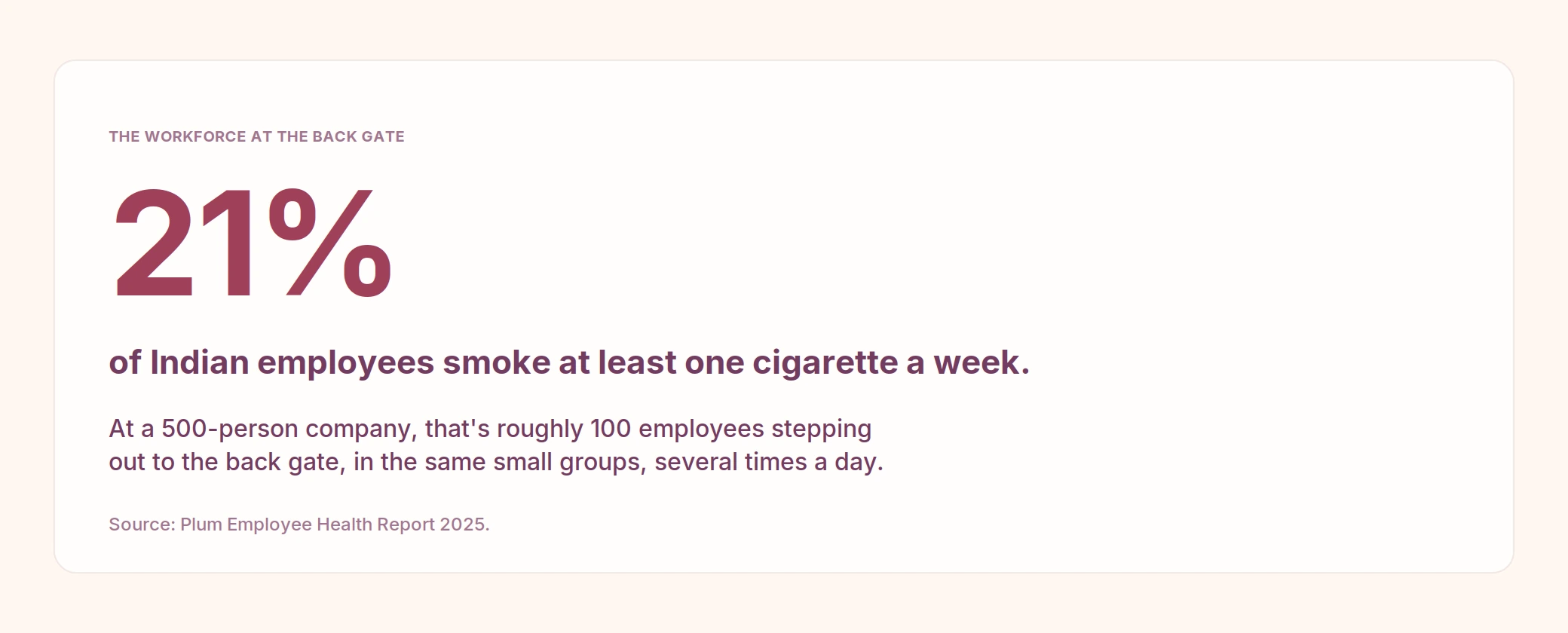
21% of Indian employees smoke at least one cigarette a week. That's from Plum's Employee Health Report 2025, and it holds remarkably consistent across company size and sector. The arithmetic that follows is uncomfortable for most HR teams. If a fifth of your headcount takes even three ten-minute smoke breaks a day, that's roughly seven hours a week per smoker at the back gate. Multiply across a 500-person company and it adds up to a number a CFO would notice.
This is why cessation programmes exist in most benefits plans, and it's also why they mostly fail. Published quit rates for unaided attempts sit in the single digits. Even structured programmes that include nicotine replacement and counselling reach only the low double digits over twelve months. The chemistry explains part of the shortfall, since nicotine is powerfully addictive. It doesn't explain all of it, though, and in the Indian workplace the rest of the explanation is social.
The smoke break is one of the last cross-hierarchy rituals left in Indian offices. Any cessation programme that ignores that is asking employees to give up nicotine and a peer group in the same week.
Consider what happens at the smoking corner. A junior developer gets a five-minute window with a founder she'd otherwise have to schedule two weeks out. A CFO hears a piece of gossip from operations that would never have made it into a status meeting. Two teams that don't share Slack channels swap notes on a client who's been unusually quiet. In most Indian offices, the smoking corner is one of the last remaining spaces where hierarchy briefly flattens and unofficial information moves freely. Employees know this, and they know that quitting means losing access to it.
There's a second social cost that people underestimate, which is identity. The smoke-break group is a small, self-selecting community with its own inside jokes and rhythms. Walking away from it means becoming someone visibly different from your colleagues, whether or not anyone comments on it. A well-meaning cessation programme that asks employees to enrol in a public support group or announce their quit date to HR makes this problem worse rather than better. It turns cessation into a more social act, not a less social one, and in the wrong direction.
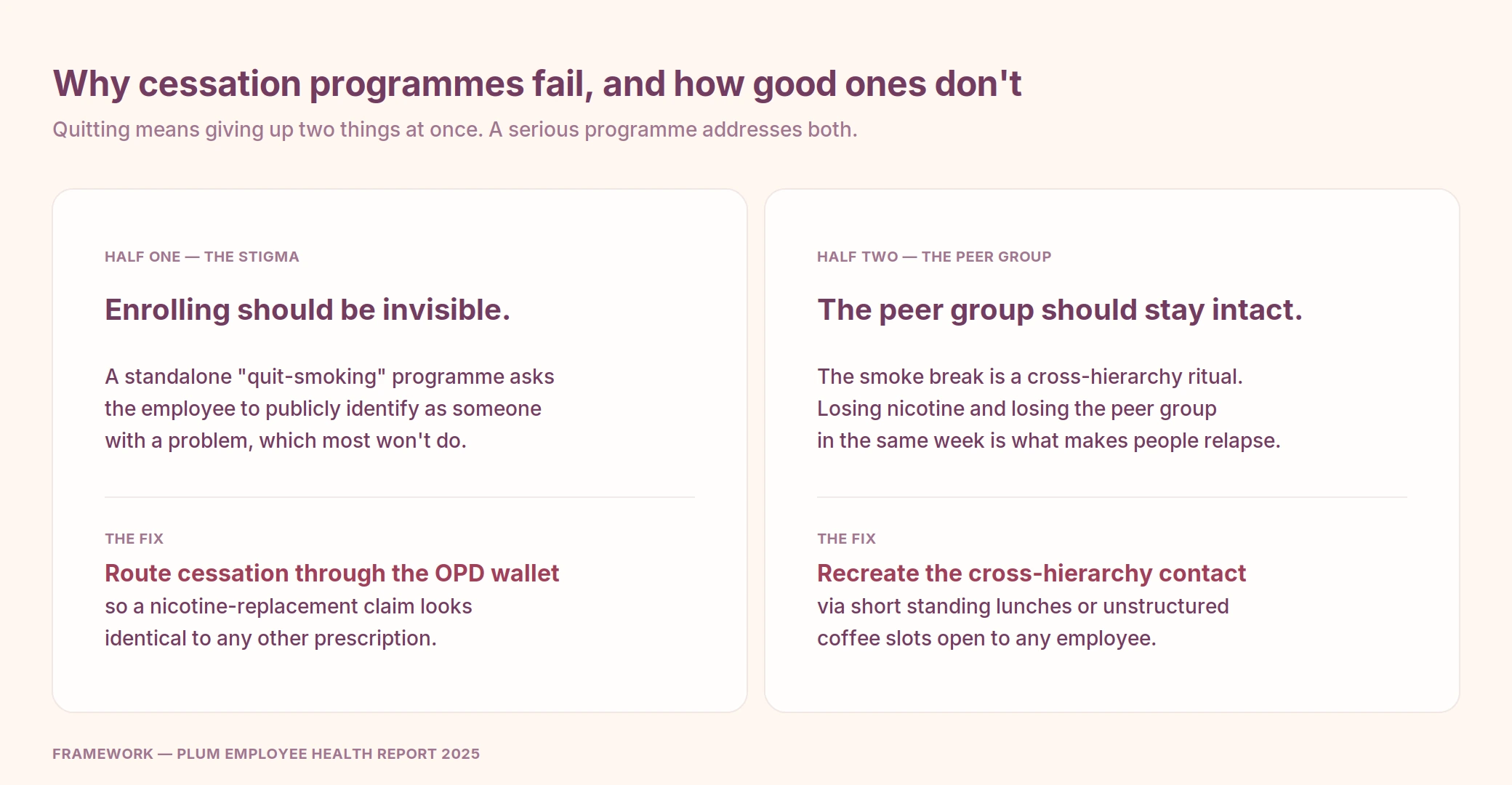
A programme that takes both costs seriously has to do two things: strip the stigma out of enrolling, and give the quitter something that replaces the connection she's about to lose.
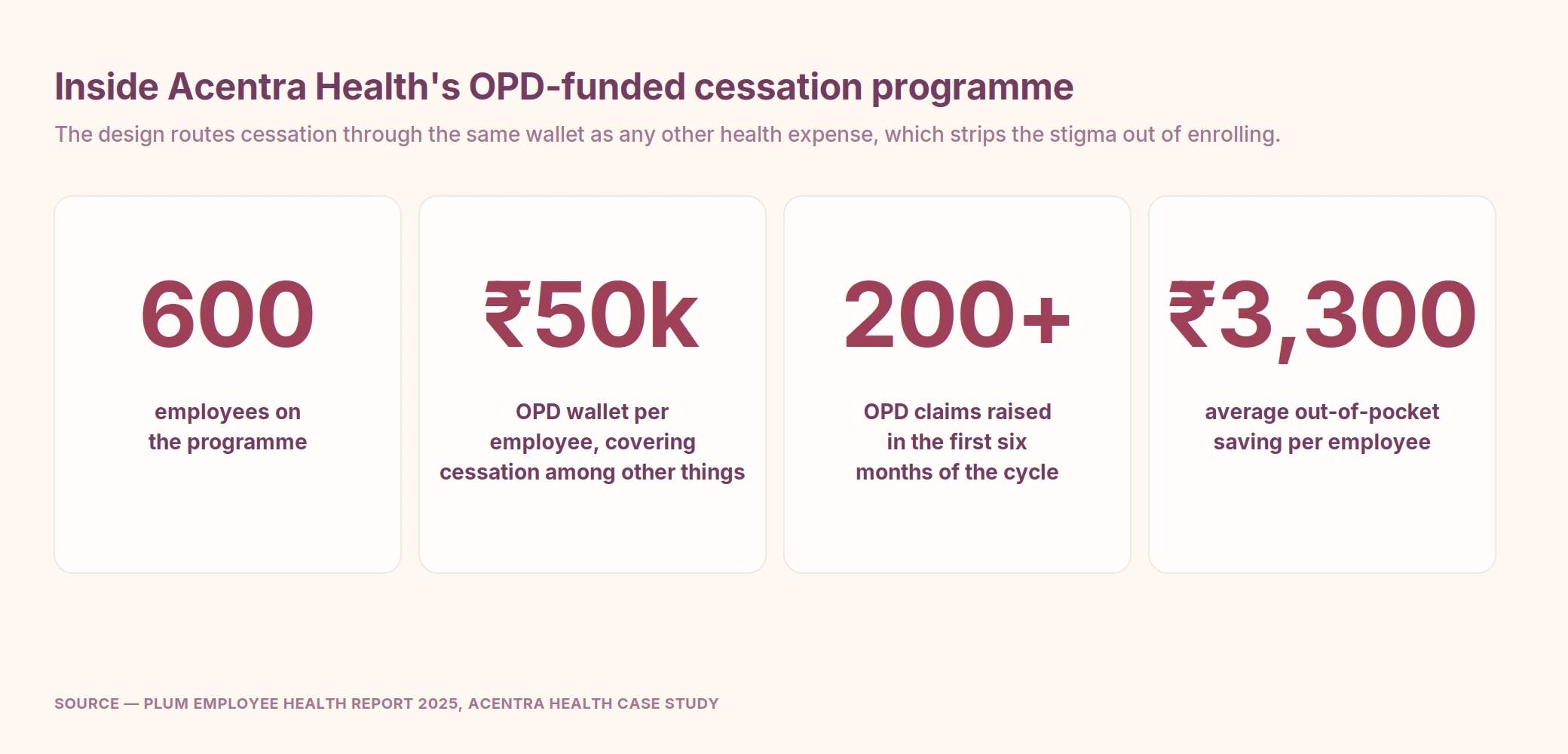
Take the stigma problem first, because it's the one you can address entirely inside the benefits plan. This is where the design of Acentra Health's benefits programme, one of the case studies profiled in Plum's Employee Health Report 2025, becomes instructive. Acentra runs an OPD wallet of ₹50,000 per employee that covers a wide range of routine spending, from doctor consultations and medicines to gym subscriptions, fertility treatments, and, notably, smoking cessation. Because everything sits under a single wallet, an OPD claim for nicotine replacement is administratively identical to an OPD claim for antibiotics. Nobody in HR is looking at a special "quit-smoking" line item, and neither is the employee's manager. In the first six months of the current cycle, over 200 of Acentra's 600 employees raised an OPD claim, with average savings of ₹3,300 per employee. Cessation doesn't appear as a separate line in that number, and that invisibility is the design working as intended.
The employee doesn't want a poster on the pantry wall. They want a way to buy a two-week supply of nicotine gum without a conversation.
What Acentra's design doesn't do, and what no benefits plan on its own can do, is replace the peer group. That takes a different set of moves, and it's the part most HR teams find harder because it involves changing something about how the office works rather than something about the plan. The companies that have moved the needle here tend to build structured alternatives that recreate the kind of cross-hierarchy contact the smoking corner offers, such as short standing lunches or deliberately unstructured coffee slots open to any employee, without making a fuss about why the alternatives exist. Done well, these give the quitter somewhere to go at 3 pm besides the back gate, and they give her the same kind of casual conversational access she'd otherwise miss.
The other useful shift is in time horizon. Most clinical cessation programmes plan around a six-week window. Most successful quitters, in practice, go through at least one relapse and one restart before the habit breaks. A programme that treats the relapse as part of the arc, and covers a second attempt without additional approval, is more useful than one that treats the first attempt as pass-or-fail. Combined with the OPD design and the peer-replacement work, this is what a serious intervention looks like: chemistry, community, and second chances, all in the same plan.
Which brings us to what to measure. Quit rates in year one are the metric HR is usually asked for, and they aren't quite the right thing. A more honest pair to track: retention among smokers who tried the programme and didn't succeed on the first attempt, and utilisation of OPD claims tagged to cessation-related spending. The first tells you whether the programme is holding people through the hardest part of the arc. The second tells you whether the design has removed enough friction that people are actually using it. Both are visible in the data any half-decent benefits platform already collects, and both can be tracked without turning cessation into a public campaign.
The smoking corner will still be there next quarter, and it should be. What a good programme changes is not whether the corner exists but whether leaving it is a survivable social decision, rather than just a chemical one.
Further reading
- Plum, Employee Health Report 2025 — the 21% weekly-smoker figure among Indian employees, and the Acentra Health OPD case study (₹50,000 wallet, 200+ claims in six months, ₹3,300 average saving).