.avif)


.avif)

.avif)







.avif)


An office job is one of the least strenuous kinds of work anyone can be paid to do. It also, over time, exacts a specific set of physical costs, and they arrive in a specific order. What follows is a body-part-by-body-part tour of what a modern corporate role charges in tax, drawn from Plum's Employee Health Report 2025, which analysed roughly 80,000 telehealth consultations across the platform.
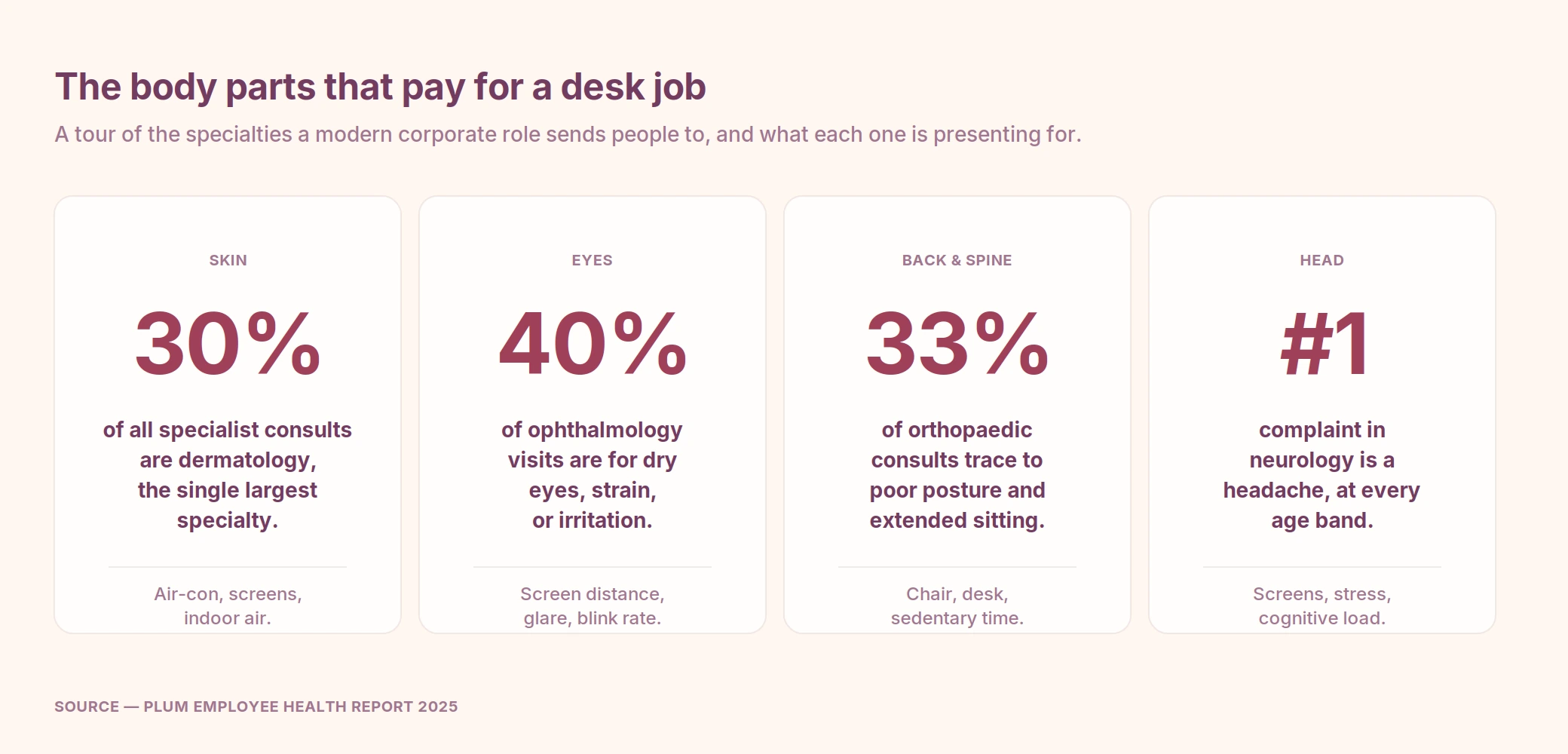
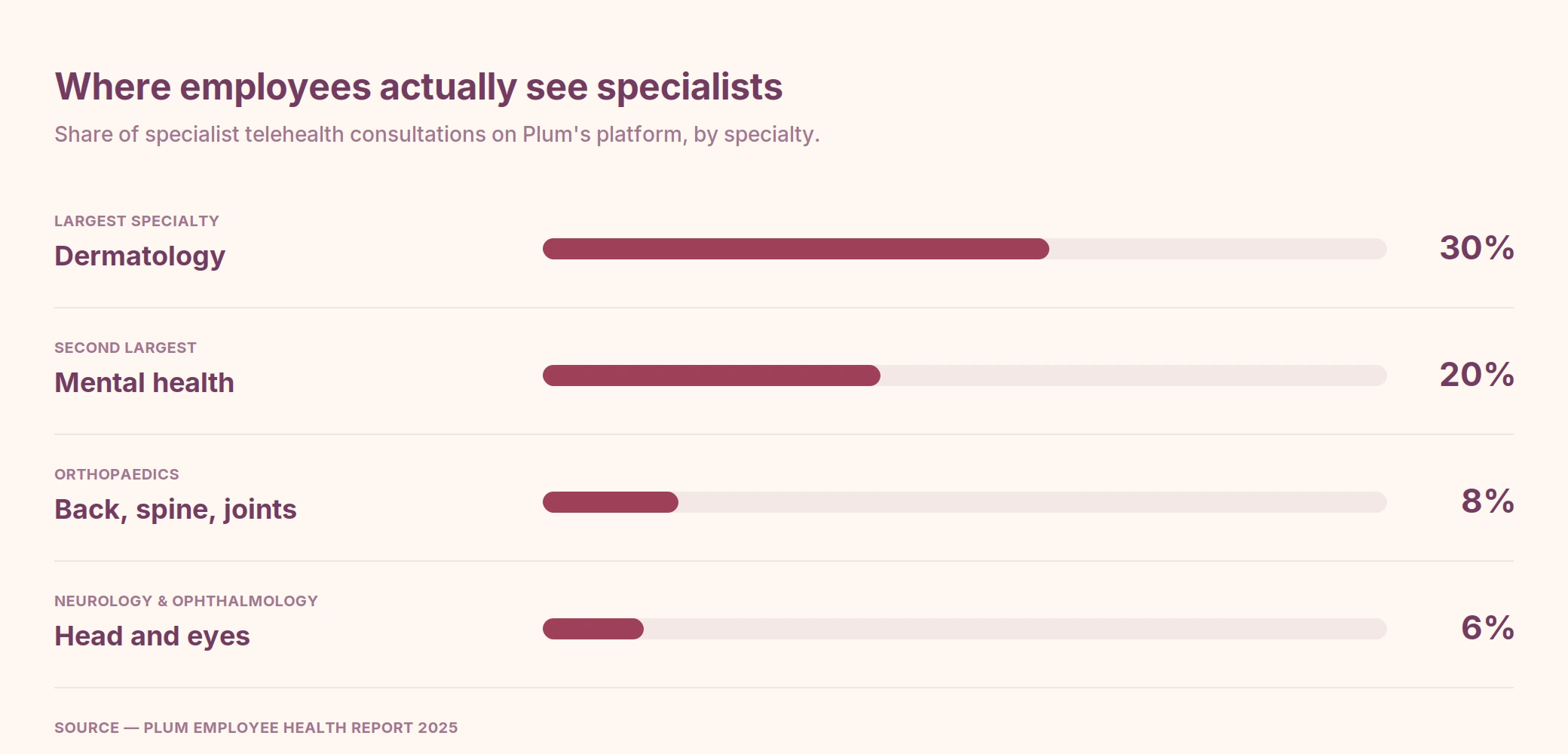
The skin. Dermatology accounts for 30% of all specialist telehealth consultations on Plum's platform, the single largest share of any specialty. The causes the report lists are the ones the average corporate employee is exposed to for eight or more hours a day: air-conditioning that pulls humidity out of the room, indoor air pollution from unfiltered HVAC systems, extended artificial lighting, and light from screens held twelve inches from the face. Nearly 60% of dermatology patients on the platform are in their twenties, with hair and acne the primary presenting concerns, which puts the age at which the corporate skin tax starts accruing much earlier than most people expect.
The report profiles the case of Karan, a 31-year-old consultant, who booked an urgent dermatology consultation before a major client presentation over an inflammatory skin condition that had been building for weeks. The dermatologist he spoke to didn't attribute the flare-up to genetics or diet. She attributed it to the specific environmental factors in his office and prescribed adjustments that were as much about his workstation as his skincare.
The eyes. Ophthalmology accounts for roughly 3% of specialist consultations, but 40% of those consultations are for dry eyes, strain, or irritation. The report calls this "a growing digital eye strain epidemic as device usage intensifies in the workplace." The clinical mechanism is well established: staring at a screen at a fixed distance for hours reduces blink rate, which reduces tear-film stability, which produces the burning and itching complaint that has become the default arrival at every corporate ophthalmology visit. The condition is treatable and reversible in the early stages. It is not usually reversible after years of un-managed exposure.
The desk job doesn't announce its costs. It presents them, one specialty at a time, five years after the fact.
The back and spine. Orthopaedics accounts for around 8% of specialist telehealth consultations on the platform, and 33% of those consultations correlate with poor posture and extended sitting. This is the tax most desk workers know is coming and least prepare for. The report is direct about the mechanism: sedentary lifestyle consequences manifest much earlier than previously recognised. A 28-year-old software developer sitting in a budget-friendly chair for eight hours a day today produces a lumbar complaint by 33, and an imaging bill soon after. The lag between the exposure and the diagnosis is what makes the correlation invisible in most benefits data.
The head. Neurology accounts for around 3% of specialist consultations, and the most common presenting complaint is a headache. The report identifies a direct correlation between headache frequency and, in its words, "stress, increased screen time, and workload." This is the body's most immediate and most easily dismissed feedback loop. A daily late-afternoon headache isn't the sort of thing most employees flag to HR, but the report identifies it as an early symptom of a working environment that has slipped out of tolerance.
There is a coherent pattern across the four specialties above, and it isn't accidental. Dermatology, ophthalmology, orthopaedics, and neurology are the four specialties most influenced by the physical environment of the workplace. The skin responds to air quality and humidity. The eyes respond to screen distance and lighting. The back responds to posture and sitting time. The head responds to screen exposure and cognitive load. These are not four separate problems. They are four separate readouts on the same underlying variable, which is the environment in which a corporate employee spends the majority of her waking hours.
A corporate job doesn't tax you all at once. It taxes you in installments, one body part at a time, and the receipts arrive years after the transaction.
The response most benefits plans have to this pattern is a group health policy that covers the eventual claims. This is necessary and it's foundational, but it addresses only the far end of the arc. What it doesn't do is fund the routine, high-frequency, mostly-OPD care that would catch each of these conditions at the reversible stage. A ₹15 lakh sum insured pays for an eventual back surgery. It doesn't pay for the twelve early dermatology consultations, the routine ophthalmology check-in, the once-a-year screening for early musculoskeletal warning signs, or the therapist appointment for a stress pattern that hasn't yet become a diagnosis.
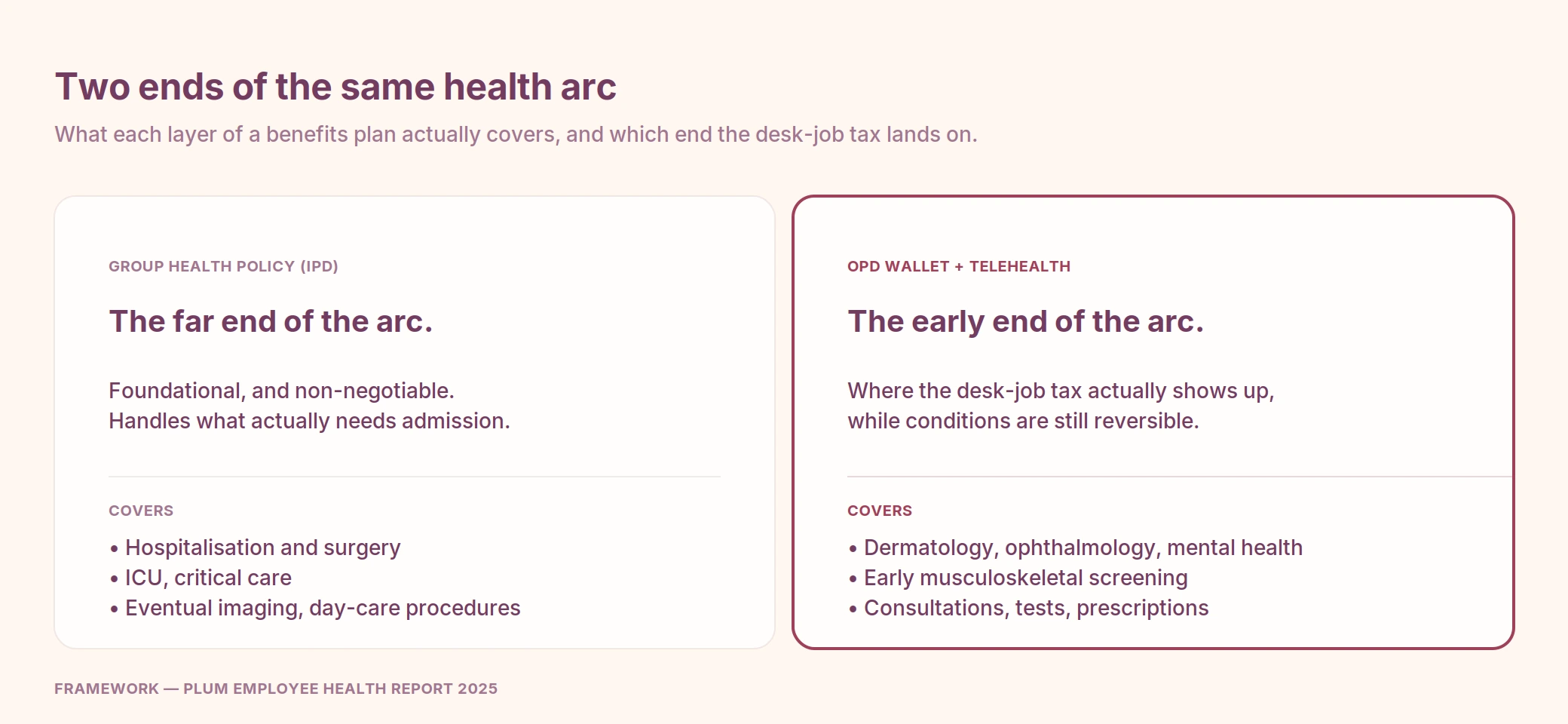
The layer that closes this gap is the OPD wallet, and increasingly, telehealth built around the specialties the corporate body actually presents at. On Plum's platform, dermatology and mental-health consultations are the two largest specialty categories by volume. Both are categories where early, low-friction access changes the outcome most, and both are ones the traditional group health policy engages with least.
The other half of the fix is the workplace itself. If the same environment is producing 30% dermatology, 40% ophthalmology-strain, 33% orthopaedic-posture, and screen-driven neurological complaints, then the environment is the primary variable. Better lighting, humidity control, air filtration, ergonomic seating, and structured breaks aren't wellness perks. They are direct interventions on the four specialties above, in a way that a bigger sum insured never can be.
None of this is an argument against the group health policy so much as an argument for the layer that sits on top of it, the one that catches each of these four accruing costs while they are still reversible. The employee doesn't need to be told her back hurts. She needs a plan that gets her to a good physiotherapist in the third week of the complaint, not the third year.
Further reading
- Plum, Employee Health Report 2025 — the specialty consultation breakdown (dermatology 30%, ophthalmology 3% with 40% dry-eye share, orthopaedics 8% with 33% posture correlation, neurology 3% with headache-as-top-complaint), and Karan's dermatology case.