.avif)


.avif)

.avif)






.avif)


Ask a benefits lead what their plan covers, and you'll get a well-rehearsed answer. A group health policy. An accident cover. A term life piece, an EAP, a discounted gym, and a suite of annual health check-ups. Ask an employee what they wish their plan covered, and you'll get a completely different list. That gap, between what benefits plans supply and what employees actually value, is the least-discussed problem in Indian corporate benefits, and it's the reason a lot of well-funded plans underperform.
Plum's Employee Health Report 2025 put the wish-list question to more than 500 employees and mapped their answers against what companies actually offer. Parental cover ranks as employees' number-one physical-health ask, and only 24% of Indian companies provide it. Outpatient (OPD) cover, including vision and dental, is the number-two ask, and only 8% offer it. Access to doctors through telehealth is number three, offered by 32% of companies. On the mental-health side, access to a quality therapist is the top ask, and offered by under 5% of Indian companies.
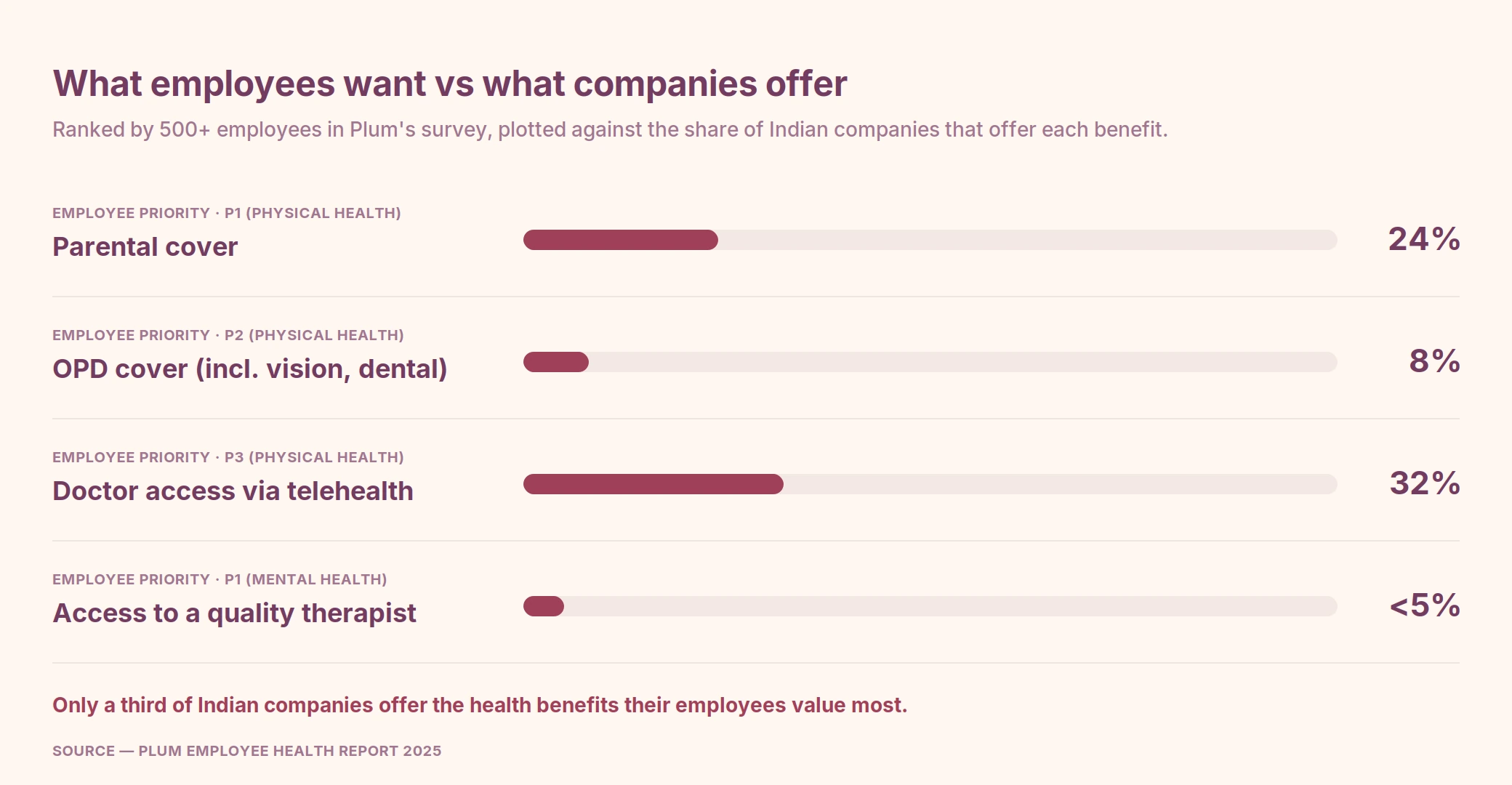
The report puts it plainly: "Only a third of companies offer the health benefits employees value most." That single figure of one-third hides a great deal of variation. Some benefits are close to universal, group health insurance being the obvious one. The specific things employees say they most want (parental cover and OPD spend chief among them) sit at 24% and 8%. Meanwhile, benefits with thinner employee demand often get generous budgets. Wellness workshops and ergonomic assessments, for instance, are common line items in plans where nothing at all is provided for a therapist.
The mismatch isn't that companies aren't spending on benefits. Many are spending well. They're just spending on the wrong ones.
The gap persists not because benefits leads don't care about employees. Most of them care intensely. The gap persists because of how benefits plans get built. A plan is usually designed once, at a moment of significant company growth like a Series B or an IPO prep, by a committee of HR and finance leads working with an insurance broker. The committee references what similar companies offer, defends the plan against a set of assumed employee needs, and lands on a design that covers what the committee thinks employees will need. Once that design is in place, it's rarely revisited from scratch. Individual benefits get bolted on when a leader notices a specific gap. The overall plan drifts.
The employees who arrive after the plan was designed often have quite different needs. A single 26-year-old with an aging parent in a smaller city wants parental cover and OPD spend that can pay for her mother's diabetes management. A 35-year-old parent wants a maternity cover that reflects real Indian delivery costs and a paediatrician within easy reach. A senior leader wants a therapist she can book without an HR intermediary. The plan, built for an average that nobody actually is, meets none of them fully.
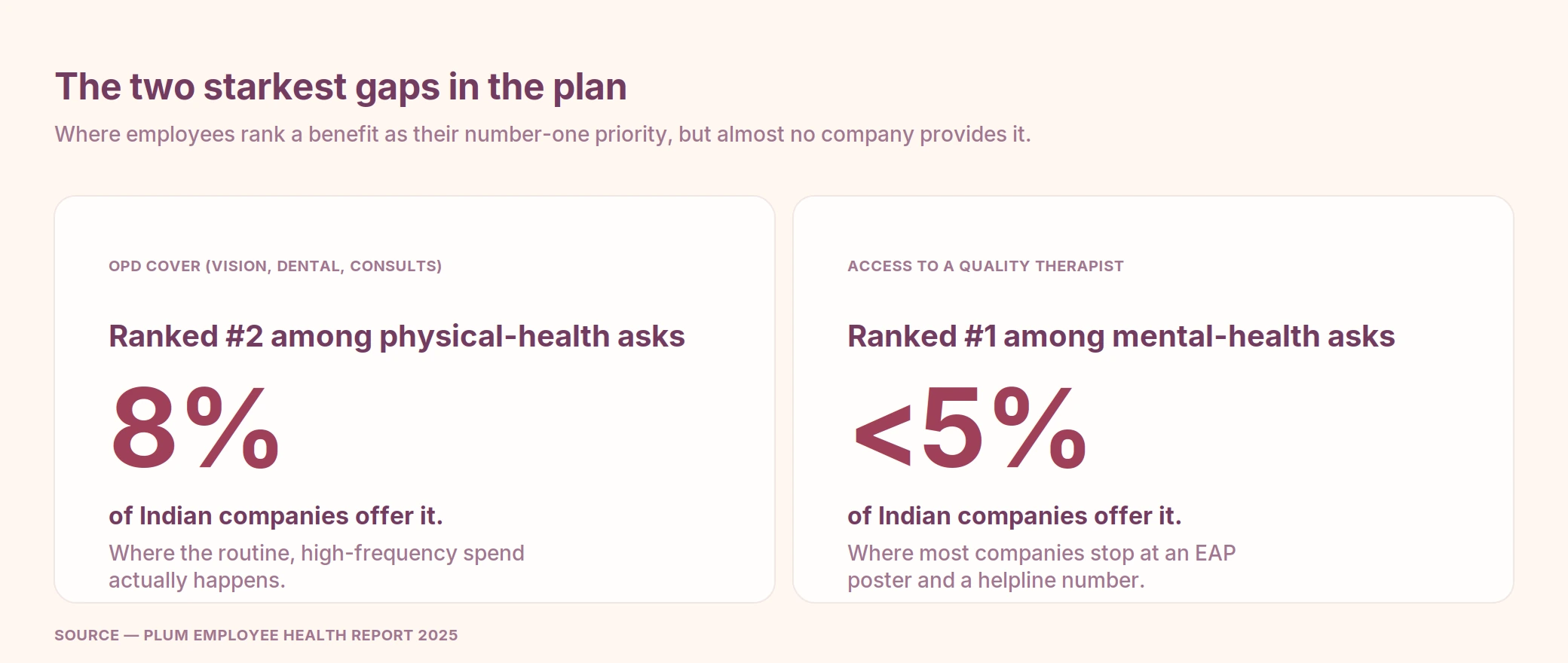
The design fix is not more benefits. It's a different way of picking them. Plum's State of Employee Benefits 2024 documented what it calls Flexcare: a plan structure where the employee, within a per-employee budget the company already sets, chooses who to cover and which add-ons matter to her. The single 26-year-old uses her allocation to add her parents and an OPD wallet. The 35-year-old builds hers around a bigger maternity limit and paediatric consults. The senior leader adds therapist access. Same per-employee budget, three completely different plans, and a 15% jump in employee satisfaction among early adopters. Around 40% of Plum's enterprise clients now offer some version of Flexcare.
The useful thing about flex is that it fixes the design problem structurally, not one benefit at a time. Rather than asking a committee to guess what employees will want in aggregate, flex hands the choice back to the employee. The committee's job shifts from designing the plan to designing the option space and the budget envelope. Everything else is a personalisation call made by the person the plan is for.
A committee cannot design a benefits plan for an employee it has never met. Flexcare is what happens when the plan admits that.
Two objections come up whenever flex is discussed, and neither is trivial. The first is that flex is complex to administer. This used to be true. Ten years ago, a Flexcare plan required manual enrolment and quite a lot of HR time. The current generation of benefits platforms has automated most of that. The operational lift is smaller than most HR teams expect, especially at the top end of the market where the tooling has matured.
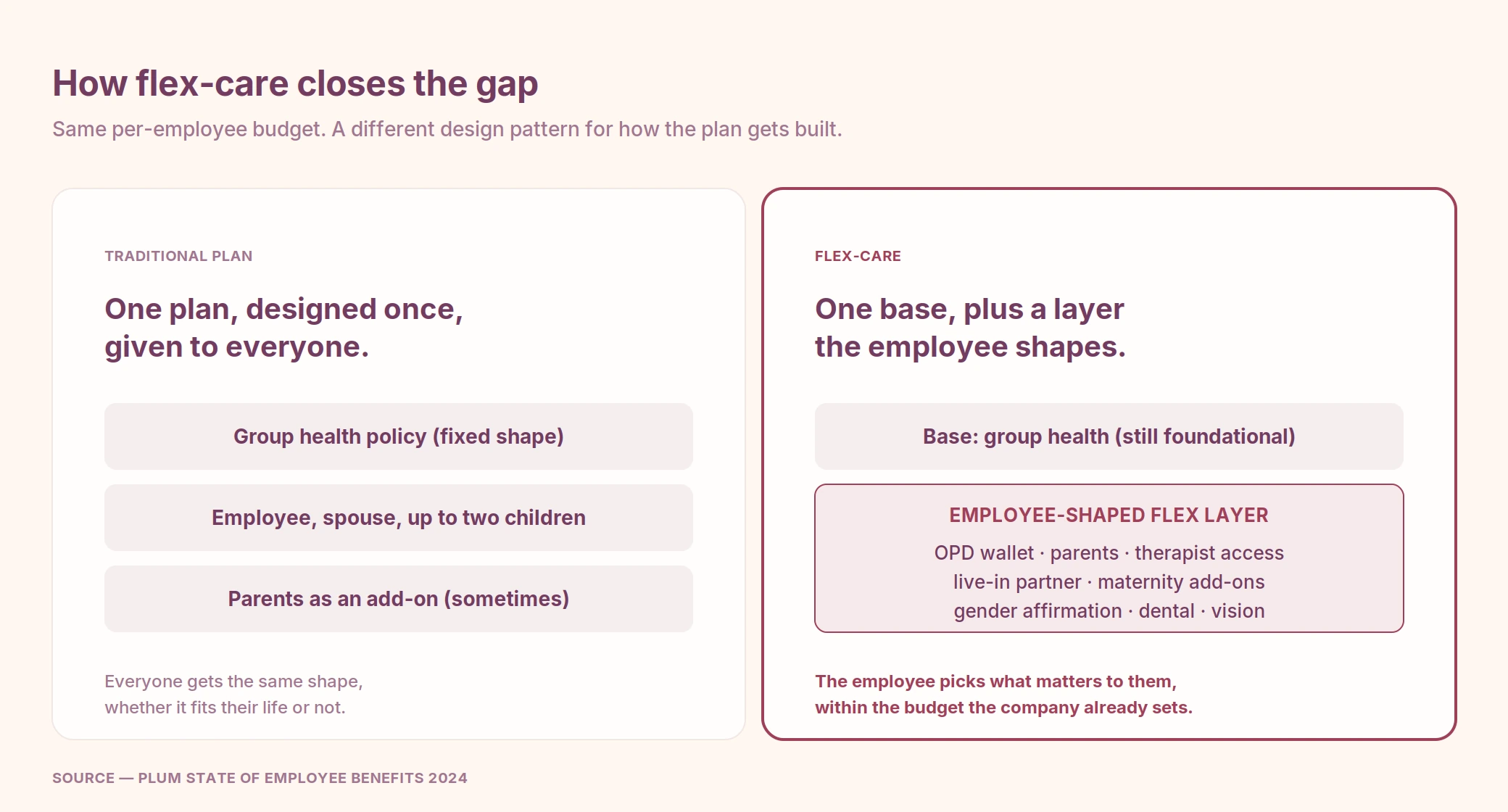
The second objection is that employees don't always know what's best for them. This one is more interesting. Certain benefits, group health and accident cover in particular, are foundational and should be provided by default rather than opted into. Flexcare in its current form doesn't strip those out. What it flexes is the layer on top: parental additions, OPD wallets, telehealth categories, mental-health coverage, wellness add-ons. This is the layer where employee preference genuinely maps to employee use, and where the wish list and the plan are furthest apart today.
The right way to think about flex is that it doesn't replace benefits design. It replaces benefits guessing. The base plan still covers what everyone needs. The flex layer covers what specific employees actually value. And employees who use their flex allocation typically report much higher satisfaction with the whole plan, because they finally feel the plan was built with them in mind.
If you're a benefits lead reading this, there's a low-cost first step worth taking this quarter. Run the same wish-list question Plum did, with your own employees. Ask them to rank the ten benefits they would most value, and compare their answers to what your current plan actually offers. The gap will tell you where flex would land first, and how big the retention risk is in the meantime.
The plan you have was designed for the company you were when it was written. The people you employ today are, in aggregate, someone else. Flexcare is the design pattern that closes the gap without asking anyone to spend more.
Further reading
- Plum, Employee Health Report 2025 — the wish-list survey of 500+ employees, and the percentages of companies offering parental cover (24%), OPD (8%), telehealth (32%), and therapist access (<5%).
- Plum, The State of Employee Benefits 2024 — the Flexcare case study, the 15% satisfaction lift among early adopters, and the 40% enterprise adoption number.