.avif)


.avif)

.avif)







.avif)


If you've raised a Series B or later, an insurance underwriter has probably spent more time thinking about your health than you have. Somewhere in your investors' file sits the medical report from your key-person policy, and the premium your company pays every year is what the underwriter decided that report was worth.
That's the awkward bit of an otherwise routine transaction. 6% of the health insurance claims Plum processes for people between 25 and 40 come in for chronic diseases that used to belong to a much older cohort. If you're a founder or a CEO in India, odds are you're in that age bracket, along with at least one other person on your leadership team. Nobody at your board table knows which one of you it is.
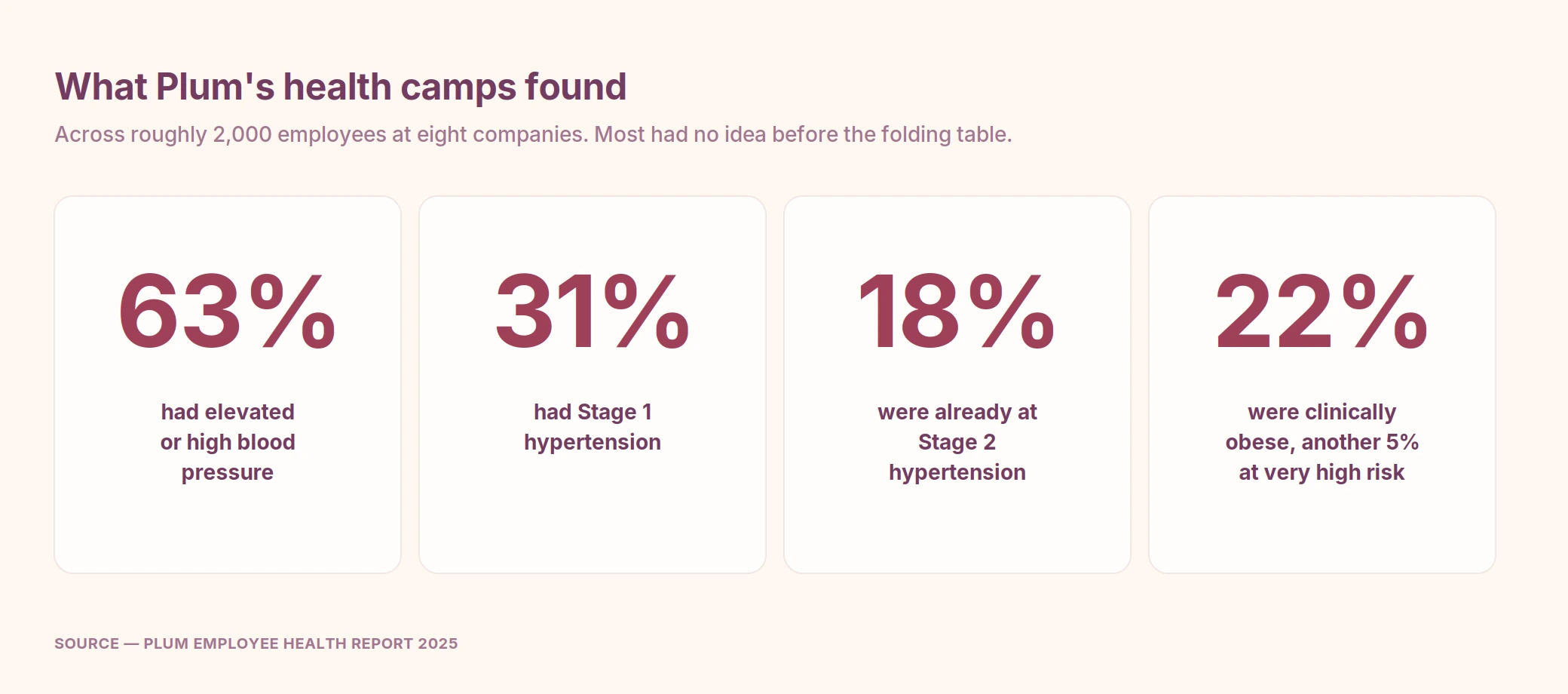
Those numbers are from Plum's Employee Health Report 2025, which draws on health-camp data from about 2,000 employees at eight companies. The camp findings make for grimmer reading than the topline. 63% of people who showed up walked away finding out that they had elevated or high blood pressure. Nearly a third had Stage 1 hypertension. Another 18% were already at Stage 2 hypertension. 22% were clinically obese. Most had no clue when they walked in.
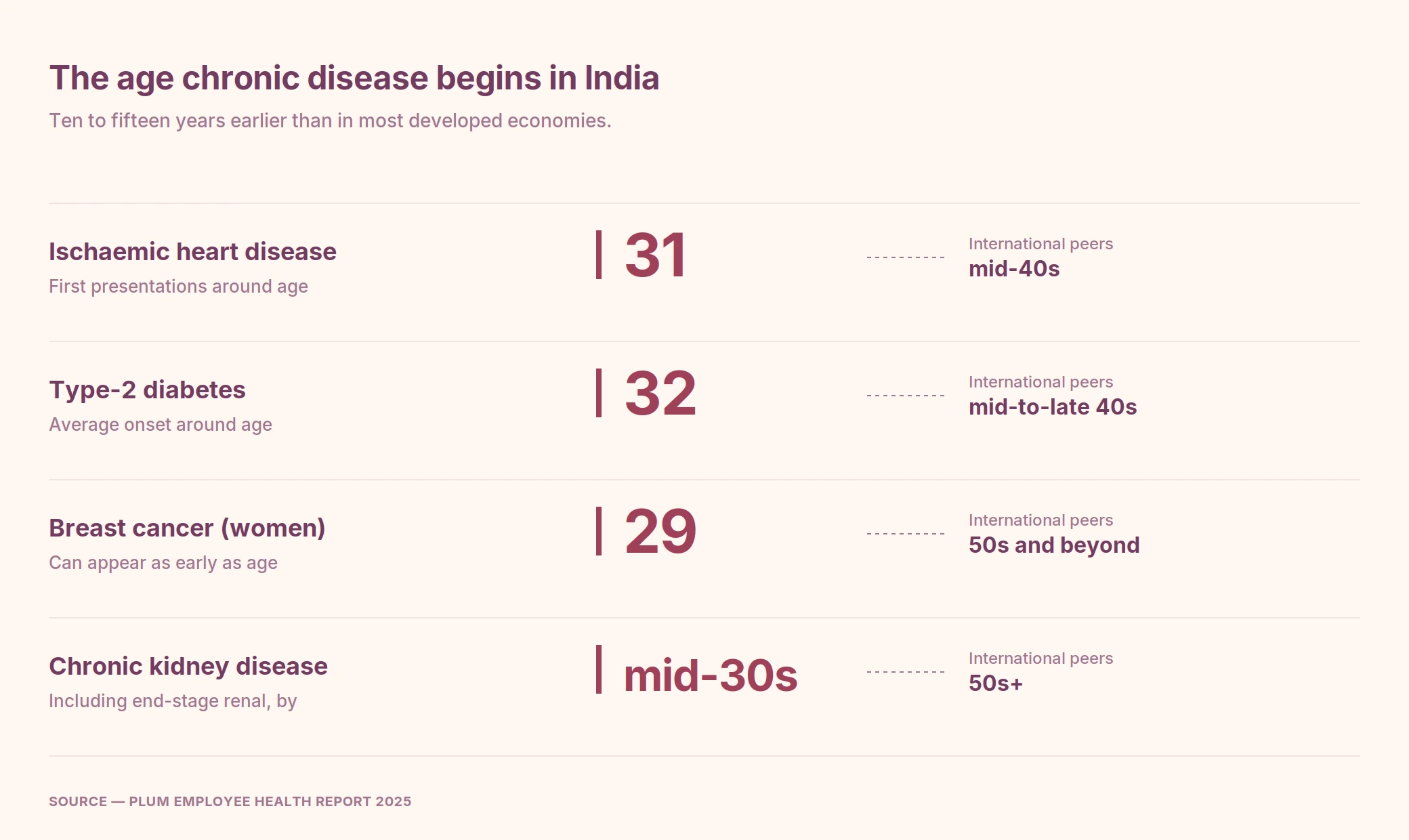
Some of this isn't personal, it's population-level. Chronic disease in Indians shows up ten to fifteen years earlier than in the countries whose executive-health playbooks we tend to imitate. There's a South Asian genetic tilt towards insulin resistance and central body fat, and it interacts badly with a life of long desk hours and a healthcare system that treats screening as an optional extra. So the numbers register in an actuary's spreadsheet before they show up as anything the patient would recognise. Ischaemic heart disease is turning up in Indians at 31.
Breast cancer in Indian women can appear by 29. Heart disease on its own accounts for 3,882 disability-adjusted life years and 135 deaths for every 100,000 people, and every top-ranked non-communicable disease in the country has a screening test that costs less than dinner with a mid-tier client.
Your CEO's blood pressure is a business metric. Every insurance underwriter has already worked that out. Most boards haven't.
Corporate governance in India hasn't really caught up with the idea of a mid-career executive falling ill. If you're listed, Regulation 30 of SEBI's LODR requires you to tell the exchanges within 24 hours if a Key Managerial Person resigns, is removed, or dies. What preceded those events isn't disclosable. When Rakesh Jhunjhunwala died in August 2022, the market got the news along with everyone else. His net worth was known to the last rupee. What his cardiologist had been telling him for years was not.
Private companies get less scrutiny but more concentration risk. Series B term sheets more or less come with key-person clauses attached now, and the insurers who write those policies, among them LIC, HDFC Life, Tata AIA and ICICI Prudential, put the founder through the medical. It's usually the first proper check-up they’ve had since college, and it often turns up things nobody was expecting. The premium the insurer quotes back is a decent approximation of how much of the company would seize up if they stepped away.
The bigger problem sits further down. Only about one in four Indian companies bothers to offer employees a free annual health check-up, and even when they do, only three in ten employees take it. When Plum runs its first camp inside a client company, sixty per cent of the people who queue up are being examined for the first time in adult life. A good number of them are in their forties. Some of them run the place.
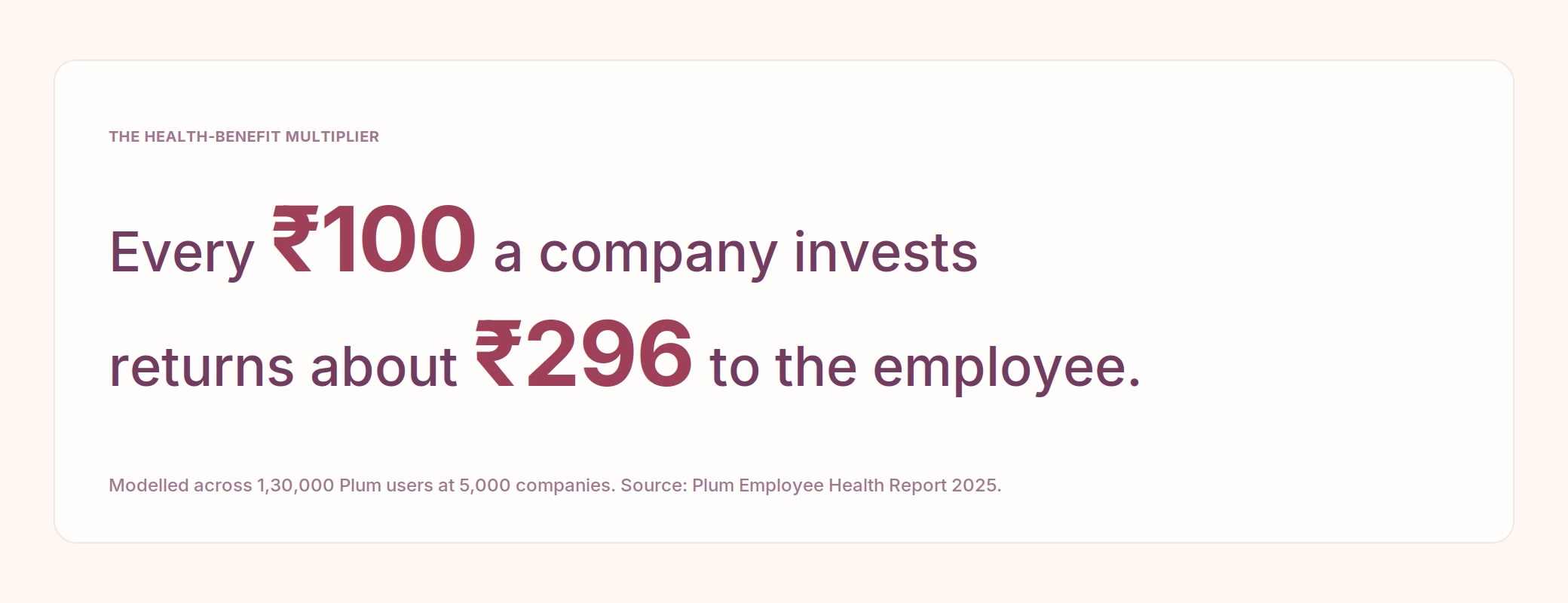
None of this makes financial sense to leave alone. Plum's own crunching of data across 1.3 lakh users at 5,000 companies works out to about ₹296 in savings for every ₹100 the employer puts in. The number is meaningfully higher when the person in question is a founder, because three weeks of an executive who can't make a decision surfaces later as a stalled fundraise or a deal that fell apart.
Companies that actually do something about this tend to do two things.
First, they treat executive screening as a scheduled event with the same weight as a board meeting. The tests that matter for people in their thirties aren't the ones anyone thinks to ask for at that age: an advanced lipid panel that goes further than total cholesterol, an HbA1c reading that flags pre-diabetes before fasting glucose does, an echocardiogram, a treadmill test. Priced against a day's worth of an executive's time, this is far simpler than a benefits programme.
Second, they personalise. Aditya Bagarka, who runs insurance partnerships at Plum, has a framework he uses with clients called the 3P philosophy of benefits planning: Prioritise, Prevent, Personalise. The last P is what matters at the top of the org chart. Your CFO gets his lipids checked because his father had an attack at 52. Your founder gets a proper look-over every couple of years because there's no plausible plan B if he doesn't.
We keep referring back to one story from the camps. Vikram, 32, a software developer at one of our client companies, entered his first half-marathon through a workplace fitness challenge. On a long Sunday run he felt a tightness in his chest that hadn't been there before, and once he got home, he called the telehealth line his company paid for. The cardiologist he saw that week picked up a minor valve irregularity, not serious but worth tracking. Rather than pull Vikram off the training plan, the doctor wrote him a new one built around specific heart-rate zones. Vikram finished the race three months later, and five of his colleagues booked screenings after they heard what had happened.
The screening was ordered. The result was received. Nothing else moved.
That, unfortunately, is the more common ending. Indian boards handle financial risk well enough and human risk barely at all. When a 34-year-old founder gets a Stage 1 hypertension diagnosis, the board should be talking about redesigning his workload and, if it's bad enough, quietly finding someone who could run the business for six months. What actually gets said is that he'll try to sleep more and eat better. The founder goes home and nothing further happens.
If your board is looking for one item to add to this quarter's agenda, make it executive health screening, and treat it like the governance question it is rather than a wellness perk. Your CEO's blood pressure is already priced into every key-person premium your company pays. Nobody in the boardroom has thought to read it that way.
Further reading
- Plum, Employee Health Report 2025 — camp data, ROI modelling, and age-of-onset framing used throughout this piece.
- Plum, The State of Employee Benefits 2024 — 4,500+ plans benchmarked; origin of the 3P framework.
- SEBI, Regulation 30 of the LODR Regulations — material-event disclosure timelines for listed entities.