.avif)


.avif)

.avif)







.avif)


The most consequential thing that happened to Indian healthcare in the last five years didn't happen inside a hospital, and it wasn't led by the state. It happened on a Zoom link, or its equivalent, between a specialist in a metro and an employee sitting in a house in Kanpur or Kottayam. It happened because two shifts collided at roughly the same time: work went remote, and healthcare went digital.
Forty per cent of the telehealth consultations Plum's platform sees now come from employees living in non-metro cities. That number, from Plum's Employee Health Report 2025, understates the change it represents. Five years ago, a software engineer working in Bengaluru who wanted to see a good endocrinologist could do so within a day or two. The same engineer, having moved back to Guwahati to be closer to family during the pandemic, would have faced a set of options ranging from long waiting lists to specialists carrying four times the caseload they should be. Telehealth, at its most useful, has closed that gap not by moving doctors to tier-2 cities, but by removing the requirement that the patient and the specialist share a city at all.
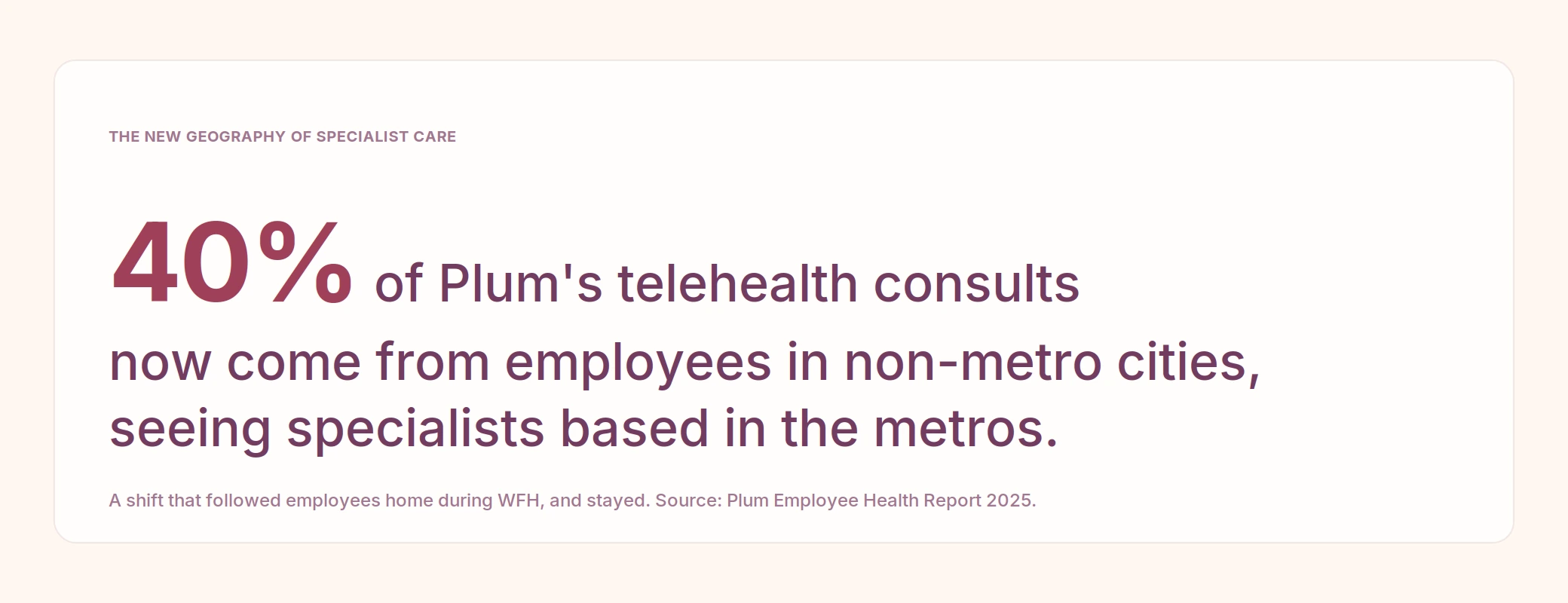
The WFH shift is the piece of context most benefits analysis leaves out. When large numbers of employees moved from Mumbai and Bengaluru to their hometowns in 2020 and 2021, many stayed. The 40% non-metro consultation figure is itself the evidence of that shift. Telehealth demand from smaller cities, on employer-sponsored plans for tier-1 companies, would not reach that level unless a meaningful share of those companies' workforces were actually living there.
Telehealth didn't set out to redistribute specialist care to tier-2 India. Instead, it followed the employees who moved there.
How telehealth found the tier-2 employee
For those employees, telehealth is not a convenience feature bolted onto the benefits plan. It is often the only way to see a specialist without a two-hour drive or a three-week wait. A dermatologist in Ludhiana with a decent reputation carries a queue that stretches into the following month. The same employee can book a Plum-listed dermatologist in Bengaluru through an app and get seen the same afternoon. The consultation happens over video, and the medication is delivered by a partner pharmacy. The friction that made specialist care in tier-2 India so slow is largely absent.
The family on the other end of the video call
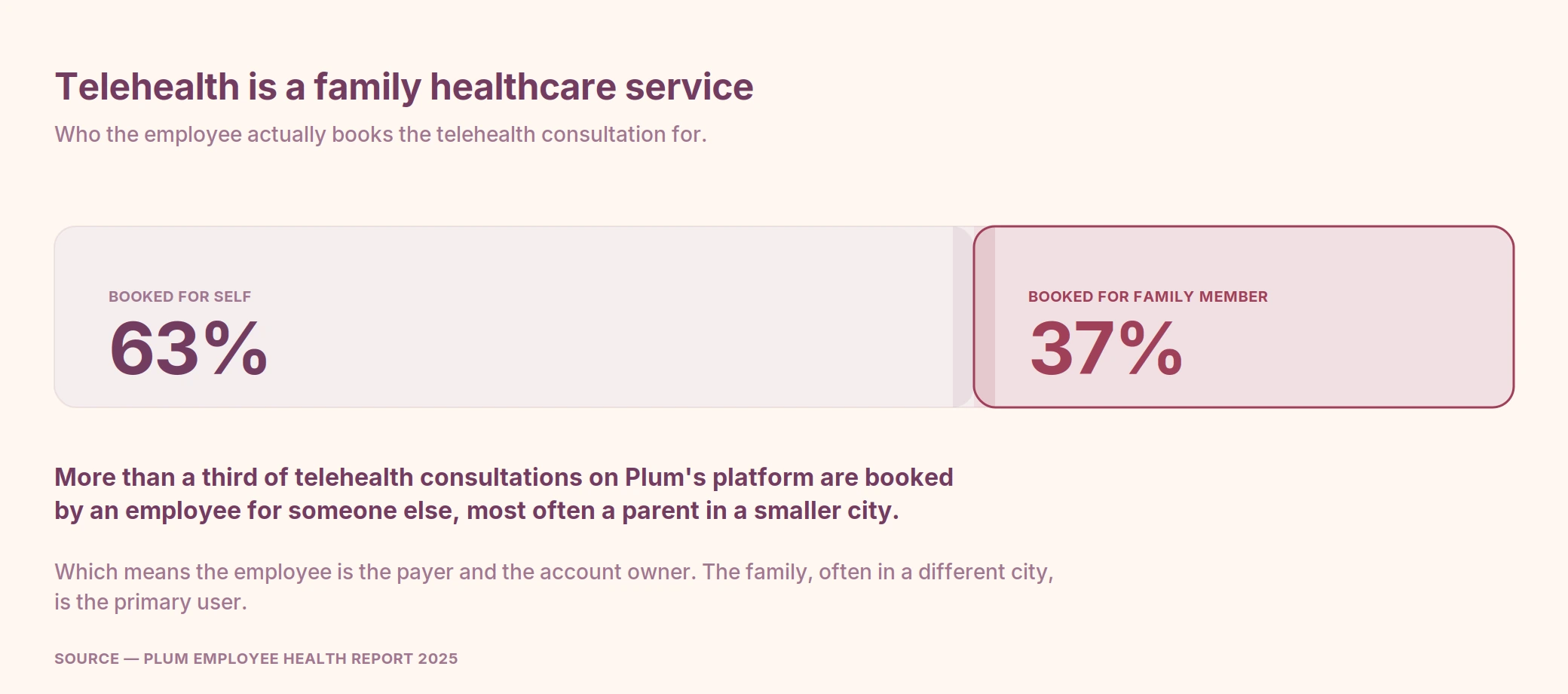
The family dimension is the second half of the shift, and the part that HR benefits leads most often underestimate. Thirty-seven per cent of the telehealth consultations Plum sees are booked by an employee for a family member rather than themselves. That number should reframe how HR thinks about telehealth; it is not primarily an employee benefit but a family healthcare service that the employee happens to book. And the family member on the other end of the video call is very often a parent in a smaller city where good specialists are harder to find.
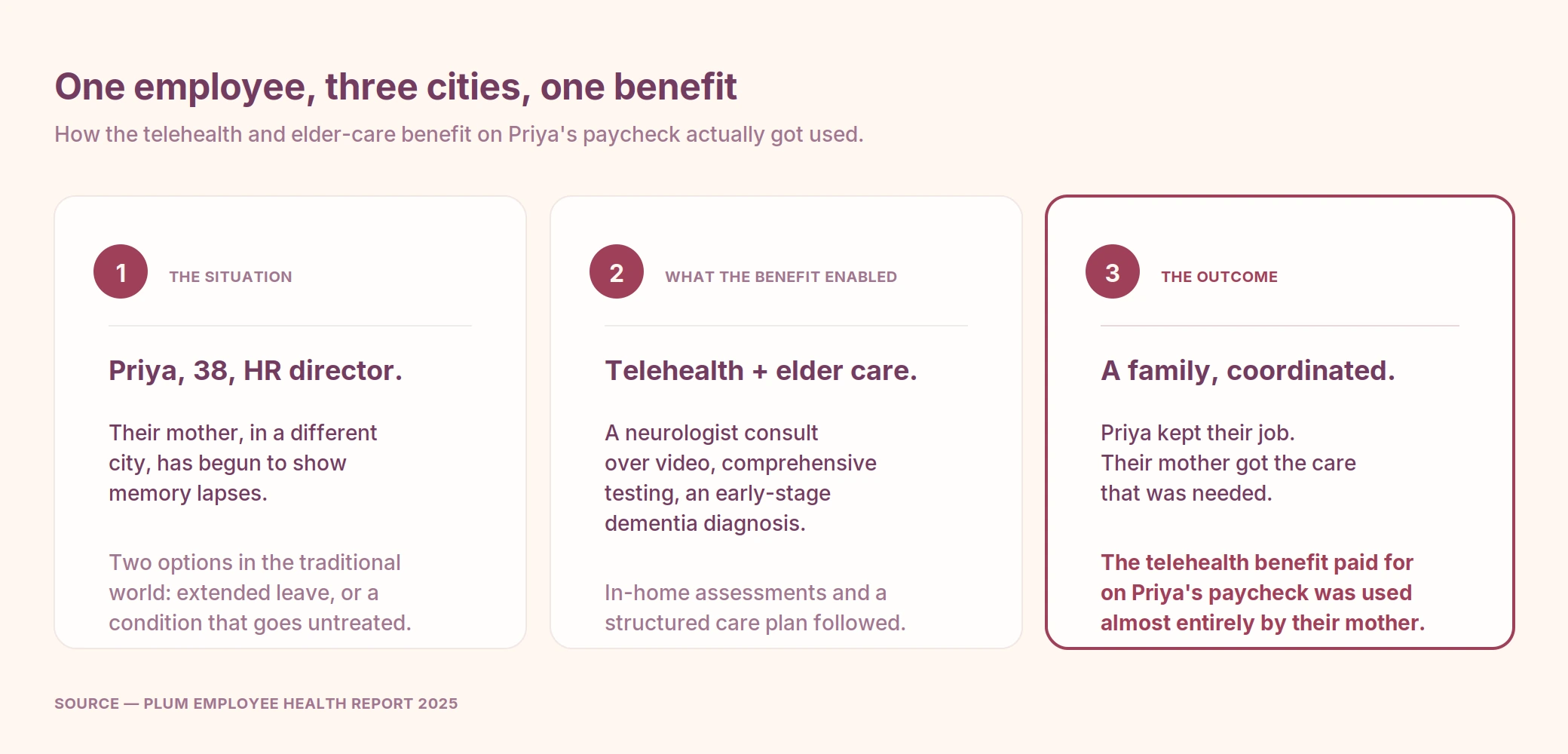
The report has one case that captures the pattern. Priya, a 38-year-old HR director, arranged a specialist telehealth consultation for her mother, who had been experiencing memory lapses. The neurologist she saw over video recommended comprehensive testing, which resulted in an early-stage dementia diagnosis. Instead of taking extended leave to coordinate care, Priya used her company's elder care support benefit to arrange in-home assessments and put a care plan together. The telehealth platform became the communication channel between Priya, her siblings in different cities, and her mother's medical team. She kept her job, her mother got the care she needed, and her family living in different cities could see updates in real time.
The telehealth benefit on Priya's paycheck was used almost entirely by her mother. That is now the norm, not the exception.
The design most plans haven't caught up with
This is a design implication most Indian benefits plans have not caught up with. The average telehealth policy still treats the employee as the primary user, with family members as an add-on or an afterthought. Plum's data suggests the opposite frame is closer to reality. The employee is the payer and the account owner. The family, often in a different city, is the primary user. Any telehealth benefit that doesn't make it easy for a parent in a tier-2 city to be seen by a Bengaluru specialist, with the employee coordinating the appointment, under-serves the majority of what the benefit is actually used for.
The extension of this logic is elder care specifically. Roughly 40% of employees say a majority of their healthcare spend goes to their parents. The traditional plan doesn't have a complete answer for this. Parental cover on the group health policy addresses hospitalisation. Telehealth for parents addresses routine specialist consultations. What Priya's company offered, an elder care support benefit that included in-home assessments and structured care planning, addresses coordination. Each of those is a different intervention, and most benefits plans provide only the first.
For a benefits lead planning next year's design, this suggests two additions worth considering. First, make sure the telehealth benefit is bookable for family members without an HR intermediary, and that a parent living in a smaller city can be added to the account with the same ease as the employee. Second, if you have a workforce that's meaningfully distributed geographically, and if you're a modern Indian company you probably do, look at whether an elder care support benefit should sit alongside the group health policy. It is a category that barely existed in Indian corporate benefits plans five years ago, and the Plum report shows what a serious version of it looks like in practice.
The broader point is that specialist care in India has been redistributed in ways the Indian corporate benefits plan hasn't yet acknowledged. A dermatologist in Bengaluru is now, functionally, a dermatologist for a software engineer in Bhopal. A neurologist in Chennai is now available to a mother in Salem. This is a healthcare-equity story that happened inside the private sector, without a policy announcement, and largely by accident. The benefits plans that recognise it and design for it are the ones that will look forward-looking three years from now.
Further reading
- Plum, Employee Health Report 2025 — the 40% non-metro consultation figure, the 37% family-booking figure, Priya's elder care case, and the ₹9,750-per-employee annual savings estimate from telehealth.