.avif)


.avif)

.avif)







.avif)


Or, more accurately: they’ll take it and probably never use it. They’ll take the ₹10 lakh health insurance too, and be glad it's there. Their actual weekly interaction with the benefits plan, though, happens somewhere else entirely. Understanding where, and why, is one of the more useful things an HR leader can do this quarter.
The numbers to start with are from Plum's Employee Health Report 2025, which parsed telehealth usage across the platform. Two are worth putting on a slide. First: "Employees in the 20-29 age group... account for approximately 60% of total consultations" on mental health. Second: "59.5% of dermatology patients are in their 20s, with hair and acne being primary concerns." A Gen Z employee, in other words, is far more likely to book a therapist or a dermatologist than to file a hospital claim.
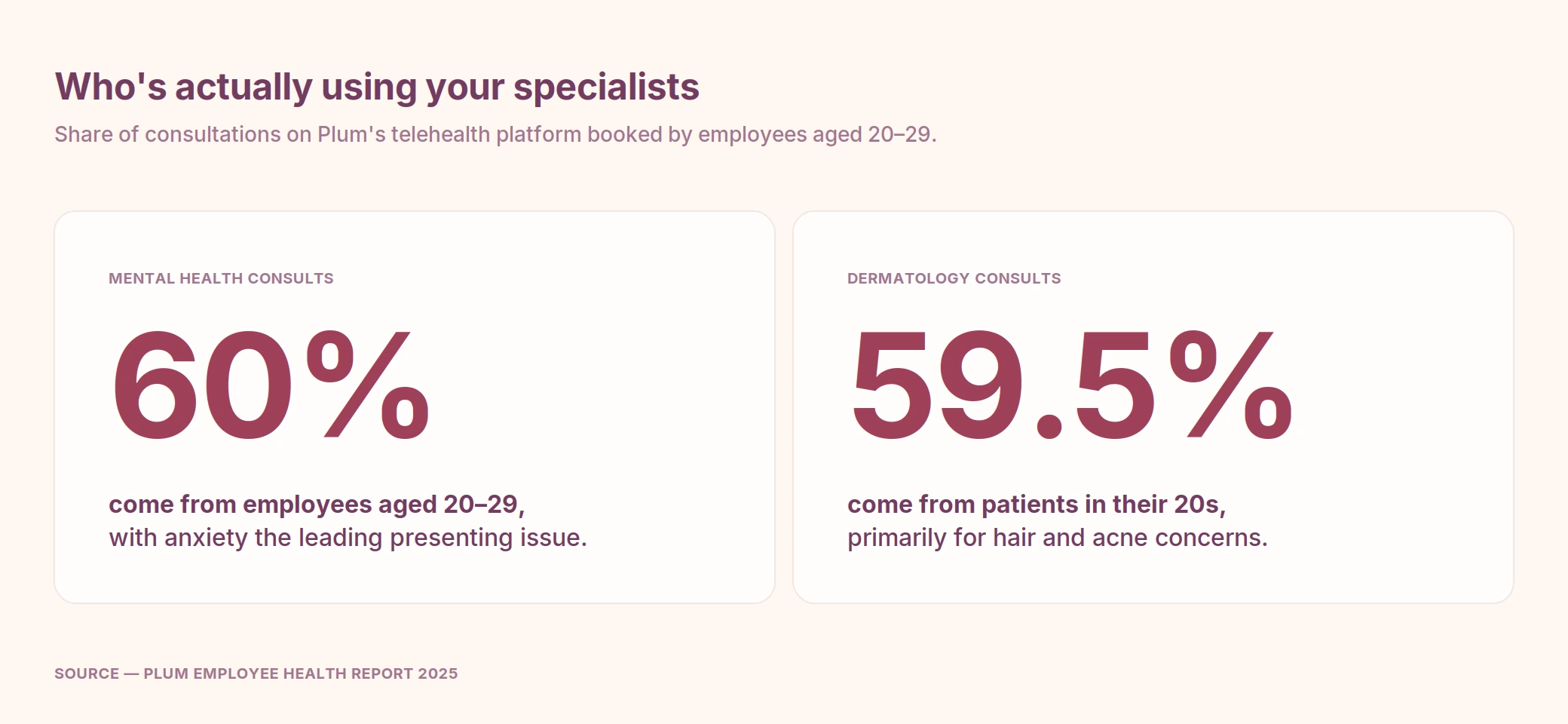
Neither figure is a surprise once you think about the life stage. Employees in their twenties are usually in their first or second job, adjusting to corporate life, often financially independent for the first time, and working through the identity questions that come with all of that. Anxiety in this cohort is not a signal of weakness so much as a reasonable response to the environment. Dermatological concerns rise in the same period because appearance matters more, socially and professionally, than at almost any other point in an adult career. Neither category is a luxury. Both are the routine healthcare of the early-career worker.
Insurance is what a benefits plan provides in case something goes wrong. OPD and telehealth are what it provides for the routine health of the person day-to-day.
Most Indian corporate benefits plans were built around an older employee profile: a married 34-year-old with children and aging parents, whose main health concern was hospitalisation and whose secondary concern was preventive check-ups. That plan design remains entirely appropriate for the employee it was built for. The gap opens when half the workforce no longer looks like that. If your median employee is now closer to 27, in a live-in relationship, and more worried about anxiety and skin than about admissions, the plan probably needs a second layer built on top of the one it already has.
That second layer is not expensive to build, and it doesn't require rethinking the plan from scratch. It usually involves three additions.
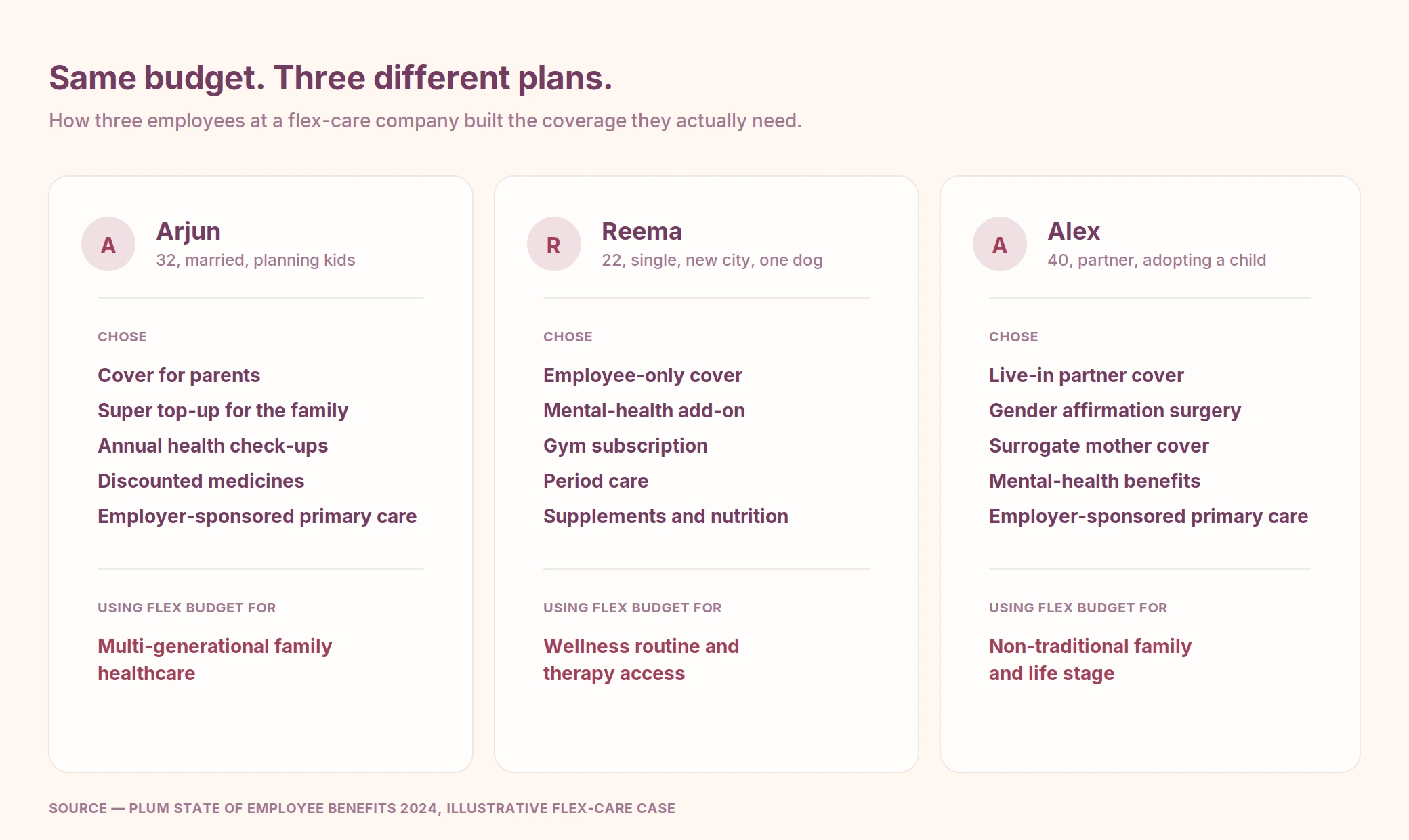
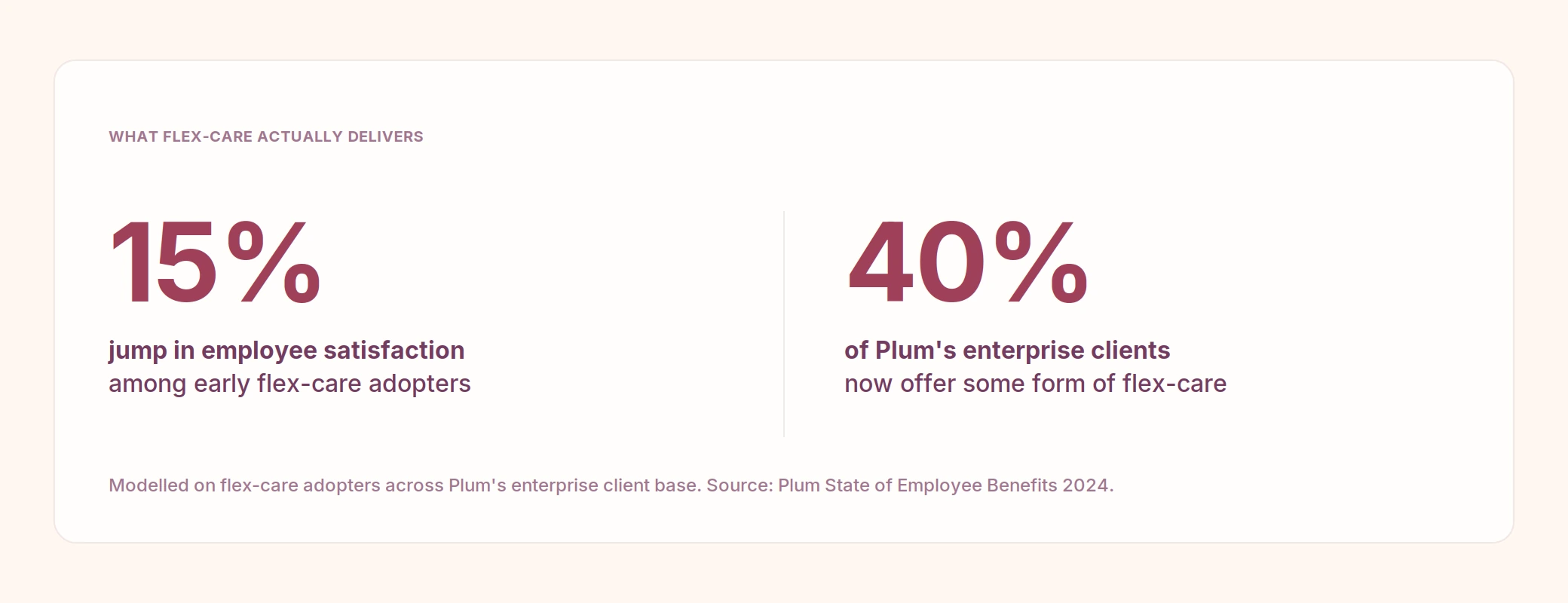
Flex-care. The State of Employee Benefits 2024 documented what Plum calls flex-care: a plan structure where the employee, within a per-employee budget the company already sets, chooses who to cover and which add-ons matter to them. One employee uses her allocation to add her parents and a super top-up. Another builds hers around a gym subscription, mental-health support and coverage for a live-in partner. Same budget, different plans, and a 15% jump in employee satisfaction among early adopters. Around 40% of Plum's enterprise clients now offer some version of flex-care, and the operational lift is smaller than most HR teams expect.
OPD spend. OPD, or outpatient department, refers to everything that doesn't require a hospital admission: consultations, diagnostic tests, prescriptions, therapy sessions. The under-30 cohort is a light user of IPD (in-patient) cover and a heavy user of OPD. A plan with a generous sum insured but no OPD wallet is a plan that sits idle for most of a Gen Z employee's year at the company. Adding even a modest OPD allowance of ₹10,000 to ₹20,000 per year changes how the employee experiences the benefit. It becomes something they use, not something they were told about at onboarding and forgot.
Telehealth built around the concerns Gen Z actually surfaces. Mental health above all, with dermatology close behind. Both should be bookable in the app, without a HR intermediary. This last part matters more than it seems. For a 24-year-old employee, the friction of having to explain to a colleague in HR why they want to see a psychiatrist is often enough to make her not do it. On Plum's platform, mental-health consultations are the single largest telehealth category, with anxiety the most common presenting issue, precisely the pattern that only shows up when the barrier to booking is close to zero.
The gap between what a plan offers and what an employee actually uses is where retention risk quietly sits.
None of this displaces anything the existing plan does well. Sum-insured hospitalisation cover is still the foundation, and an annual master check-up is still useful for the older half of the workforce. The gym membership is still appreciated by the people who use it. The point is that if half the workforce is now under 30, the plan has to work for that half as well as the other. It doesn't require replacing anything the plan already includes, only adding what it currently doesn't.
A helpful diagnostic to run this quarter, with no budget conversation attached: ask five employees under 27 what they wish the plan covered that it doesn't. Their answers will tell you where the gap is and how much of it can be closed within the budget you already have. Whatever they name will almost certainly be less expensive than the retention cost of not having it.
Further reading
- Plum, Employee Health Report 2025 — the 20-29 cohort's share of mental-health and dermatology consults, anxiety-first framing, and the telehealth breakdown by specialty.
- Plum, The State of Employee Benefits 2024 — the flex-care case study, the 15% satisfaction lift among early adopters, and the 40% enterprise adoption number.